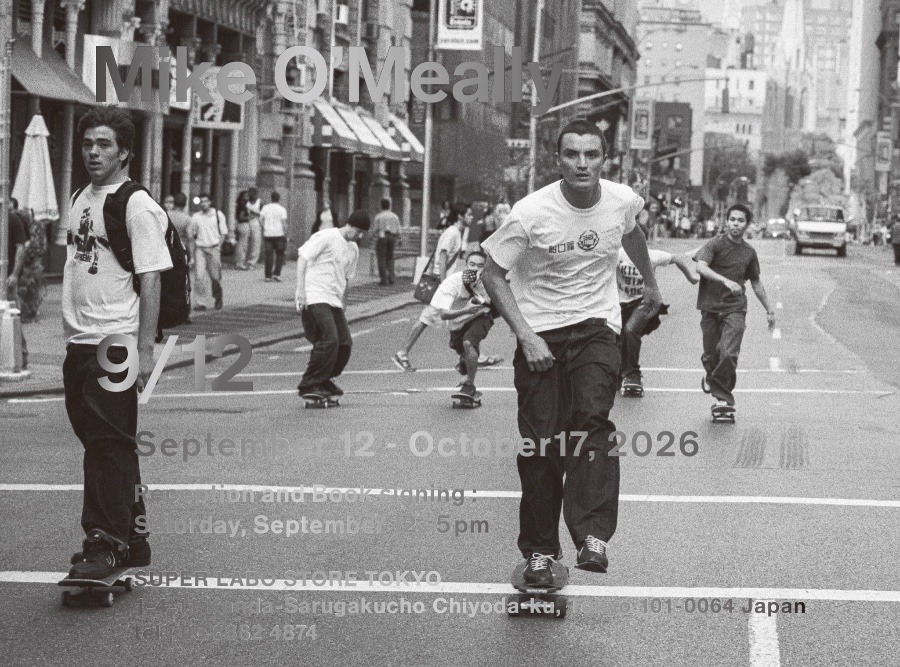




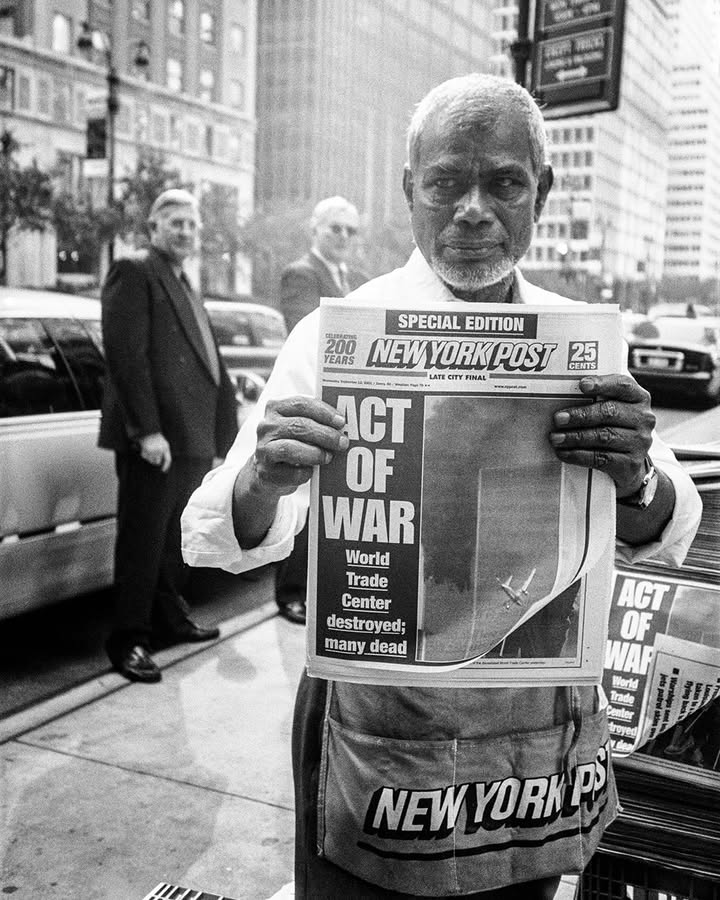
On September 12, 2001, the day immediately following the tragedy on the World Trade Center, Mike O'Meally took to the quiet streets of Manhattan on his skateboard alongside Jeff Pang, Todd Jordan, and crew. Decades later, O'Meally collaborated with director and editor Jeremy Elkin to curate and assemble these rare contact sheets into a photo book titled "9/12." The result is a rare document of a city in shock—and of skateboarding as a way to keep moving through it.
──MIKE O'MEALLY & JEREMY ELKIN
[ JAPANESE / ENGLISH ]
Special thanks_SUPER LABO
VHSMAG (V): Where were you when the tragedy occurred on September 11, 2001?
Mike O'Meally (MO): I was in New York City. By sheer coincidence, I had taken a flight back from Los Angeles on September 10. I stayed out late that night, so I slept in on the morning of September 11 and woke up to my mother calling me all the way from Australia to tell me what had happened. I ended up living in New York from mid-1998 to about 2004 or 2005, spending 23 years total in the US before moving back to Australia where I live now.
Jeremy Elkin (JE): I was only 14 or 15 years old at the time and living in Montreal, but my mother’s side of the family is from New York. I traveled down to New York a couple of days after September 11 to support a family member who ultimately passed away about a week later as a result of the attack, so I was in the city throughout that week.
VM: What made you decide to head out with your skateboard on September 12?
MO: First of all, I got sick of staring at the television, watching the news reports and the constant replaying of the crash and the towers falling down. Spending too much time inside felt unbearable. It felt scary to step outside, but staying inside felt even worse, so I just needed to get out into the city and see what was happening.
VM: How did the session come together, and where did you go?
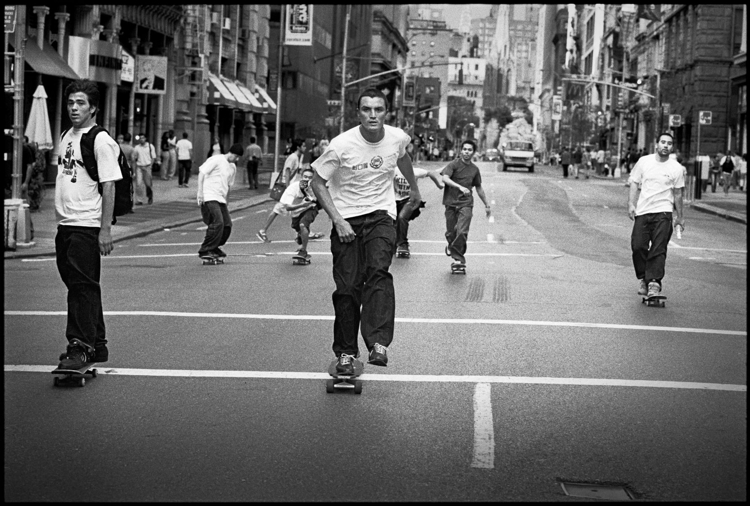
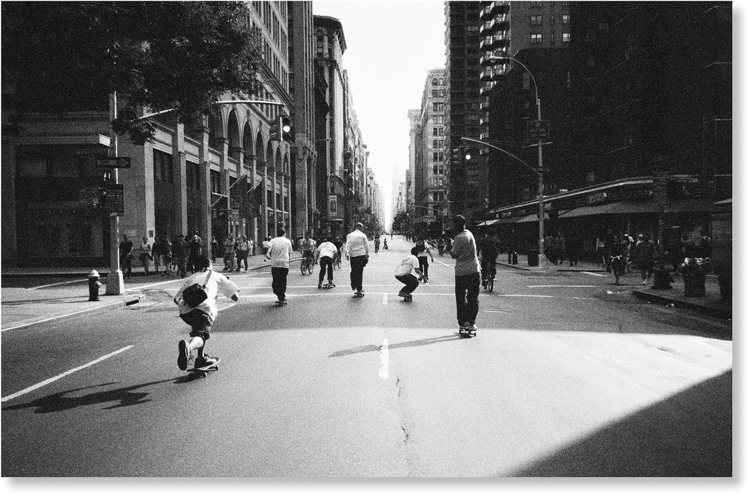
MO: We met up at Union Square with Jeff Pang, Todd Jordan, and the rest of the crew. We skated up toward Midtown, not to look for skate spots, but just to check everything out. We got as far as Grand Central Station, then skated back down to Houston Street, made a right turn over to the West Side Highway, and that was as far as we went. We skated around for maybe two to three hours at most.
VM: What sensory details stand out in your memory from that day?
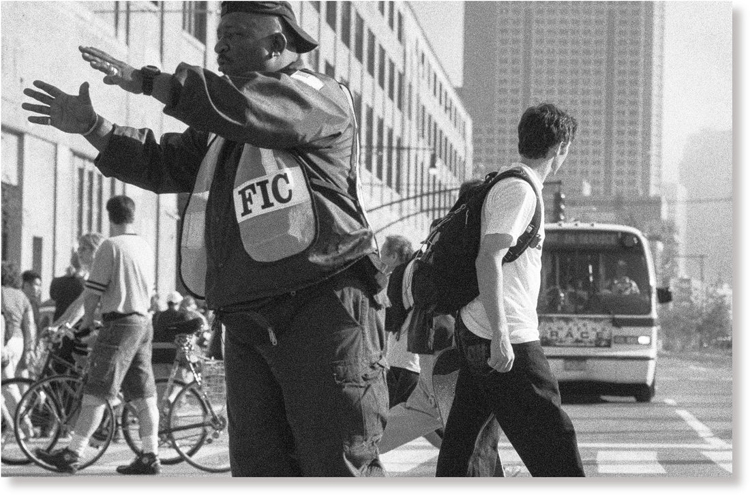
MO: Specific conversations from that day are very foggy, but I distinctly remember the sounds of sirens, the noise of jets flying overhead, and the smell of the towers. When I got my film back, the main thing that struck me was how completely empty the streets were of cars. We were pushing down the middle of Broadway with no taxis, no buses, and no regular traffic, except for emergency vehicles moving through.
VM: How did this project evolve into the photo book "9/12" over two decades later?
MO: It came about by coincidence. Last year, I got to talking with Jeremy and showed him these photos, which I hadn't done anything with for years. He was really interested and asked if he could show them to Yasunori (Hoki) at SUPER LABO. Once Yasunori expressed interest, Jeremy took full charge of the project, handling the edit, layout, typography, typesetting, page count, and the visual flow of the pictures. Having him edit the work was invaluable because when it's your own work, you often can't see the forest for the trees.
VM: Jeremy, how did you approach editing and sequencing Mike's photographs?
JE: My background is in motion pictures, so I view still photographs like individual film frames. You put a sequence of frames together to create flow so the reader feels like they are watching something happen. Compared to editing a feature documentary with hundreds of thousands of hours of video footage, working on a photo book is very light and manageable. I focused on selecting the strongest images that distilled the event into a simple, clear visual narrative.
MO: When I saw Jeremy's initial edit, I was blown away. I just saw individual snapshots from an aimless day, but he uncovered a clear narrative that made complete sense.
VM: How much of this archive had been published prior to this book?
MO: Only six to eight photos had ever been seen before in the Skateboarder Magazine article titled "The Day the Town Went Quiet." Jeremy was really the first person to see all the contact sheets. Within a week or two after giving him the materials, he sent back a completed edit that was 80% to 90% done.
VM: People often point out Jeff Pang pushing on a longboard in the main photo. What was the setup that day?
MO: Jeff made a smart choice riding a big, fast board with comfortable Nike shoes because he knew we would be pushing across town. I was actually riding a 10-inch by 36-inch longboard with large soft wheels, which allowed me to skate backwards shooting photos in front of everyone without tripping over manhole covers.
VM: Why was it important to title the book "9/12"?
MO: For years, many people assumed the famous photo of Jeff Pang was taken on September 11 itself. Titling the book "9/12" explicitly sets the record straight that these photos were taken on the day after the tragedy.
VM: Do each of you have a personal favorite image from the book?
MO: One photo that stands out to me shows a guy embracing his girlfriend and resting his head on her shoulder.
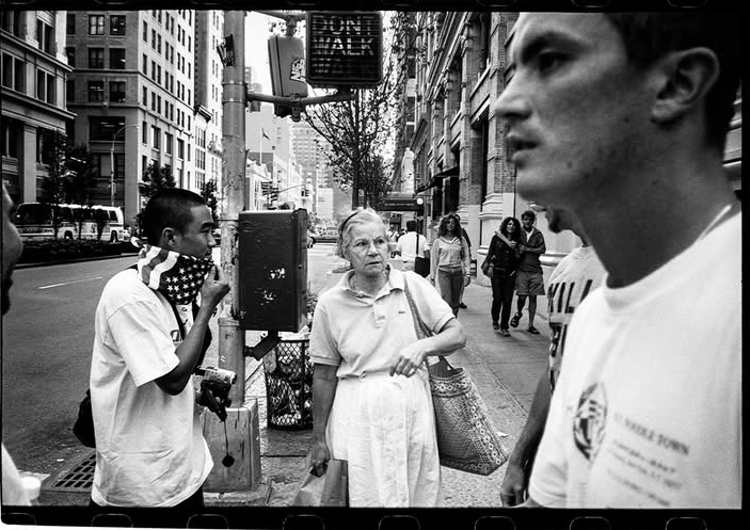
JE: I love the shot on Park Avenue of an elderly woman talking to Jeff Pang, with Eli wearing a 'Kill Bin Laden' t-shirt and Spencer holding his camera on the left.
VM: Looking back after 25 years, what does "9/12" represent to you?
JE: To me, these photos represent the start of a new New York and a new decade for the city, a distinct chapter before the city became heavily gentrified. It marks the very first day of rebuilding Lower Manhattan.
MO: To me, it is a capsule of a terrible time in New York, but it ultimately represents the resilience of New Yorkers. For a long time, I worried people might view skating that day as a cavalier or disrespectful reaction, but looking back, I realize it was a completely natural emotional release for people our age to process tragedy and find bravery. It is a reminder that even after experiencing a massive tragedy, you can pick yourself up, persevere, and keep going. For us as skateboarders, going out that day was a natural way to process our emotions and find a sense of bravery.
Mike O'Meally - 9/12
Edit: Jeremy Elkin
Publisher: SUPER LABO
Buy here: SUPER LABO - 9/12 by Mike O'Meally
Mike O'Meally
@mikeomeally
Australian photographer who has documented skateboarding and its surrounding culture since the early 1990s. After working for SLAM in Australia, he moved to New York in 1998 and went on to shoot for SLAP, Skateboarder, TransWorld, and numerous brands and publications worldwide. His photographs from September 12, 2001 form the foundation of the photo book 9/12.
Jeremy Elkin
@jeremyelkin
Canadian director, photographer, and editor who grew up in Montreal and began filming skateboarding as a teenager. After moving to New York, he worked in video production at Vanity Fair and went on to direct the acclaimed documentary All the Streets Are Silent. For 9/12, Elkin curated, edited, and sequenced O'Meally's previously unseen archive into a visual narrative.